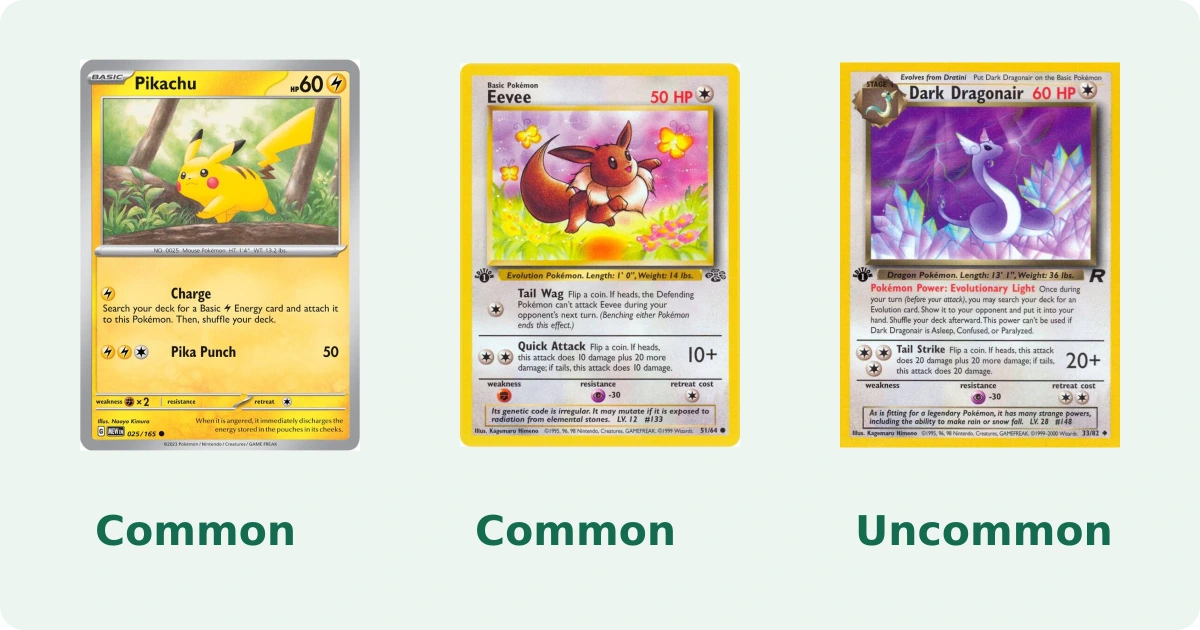
Yes, some basic-looking Pokémon cards are worth money. Many ordinary modern commons and uncommons have a small individual value, but older printings, sought-after Pokémon, particular variants and useful cards can be worth checking before you put them in a bulk pile.
The important question is not just “does it look rare?” It is “which exact card and printing do I have?” A plain, non-holo card can deserve a closer look, while a shiny card is not automatically valuable.
What do you mean by “basic Pokémon cards”?
Collectors use “basic” casually to mean ordinary cards, but the word can also point to something quite different:
- Ordinary-looking cards: usually commons, uncommons or non-holo cards. This is the main focus of this guide.
- Basic printed at the top: the Pokémon's evolution stage. It is not a rarity or value rating.
- Base Set: the original expansion, with its own cards and printings. A Basic Pokémon can come from many different sets.
A Common card is usually marked with a circle, an Uncommon with a diamond, and a Rare with a star. These markings are separate from whether the card has foil. Some non-holo cards are Rare, and Common or Uncommon cards can also have reverse-holo versions.
If you are unsure where to find those details, our illustrated guide to reading a Pokémon card shows you exactly where to look.
How much are ordinary Pokémon cards worth?
There is no useful single price for “a basic Pokémon card”. A recent common from a widely opened set and a specific vintage printing belong in different comparisons, even if both have a circle rarity symbol.
For a box of modern commons and uncommons, expect many cards to have modest individual prices. That does not mean they have no purpose: people use them to finish sets, collect favourite Pokémon, build decks and introduce children to the game. It does mean that a shop's bulk offer will not necessarily equal the sum of individual retail listings.
Separate anything that needs identifying before valuing the rest as bulk. The examples below show why that extra check can matter.
Real examples: ordinary appearance, different values
These are selected comparison examples, not a ranking of the most expensive common cards. Reference prices are USD market estimates for ungraded English cards, with individual condition unspecified, observed on 27 October 2026. Match the exact printing and condition when comparing your own copy; these are not guaranteed sale prices.
| Card and printing | Rarity | Reference price (USD) | What to notice |
|---|---|---|---|
| Pikachu 025/165 — English 151, normal non-holo | Common | 0.28 | A familiar Pokémon does not automatically make an ordinary modern printing expensive. |
| Charmander 046/102 — Base Set, Unlimited | Common | 3.67 | Older non-holo cards can have an individual market. |
| Charmander 046/102 — Base Set, unstamped Shadowless | Common | 14.32 | The same name and number can have a different value when the printing changes. |
| Eevee 51/64 — Jungle, 1st Edition | Common | 17.04 | The small edition stamp is worth checking. |
| Dark Dragonair 33/82 — Team Rocket, 1st Edition | Uncommon | 13.79 | A diamond rarity symbol does not mean a card should automatically go into bulk. |
You can compare the relevant cards and versions in our Pokémon 151, Base Set, Jungle and Team Rocket card lists.
Why the Charmander comparison matters
The two Charmander examples share the collector number 046/102. Searching only that number or only “old Charmander” can bring up the wrong comparison.
For English Base Set Pokémon cards like Charmander, inspect the artwork frame and the edition stamp. The unstamped Shadowless printing lacks the drop shadow beside the picture; Unlimited has the shadow. The 1st Edition printing has its own stamp and is another comparison again. Do not apply this shortcut to every set or every card type.
That is the difference between identifying a collectible and simply recognising its artwork.
The little details worth checking on old cards
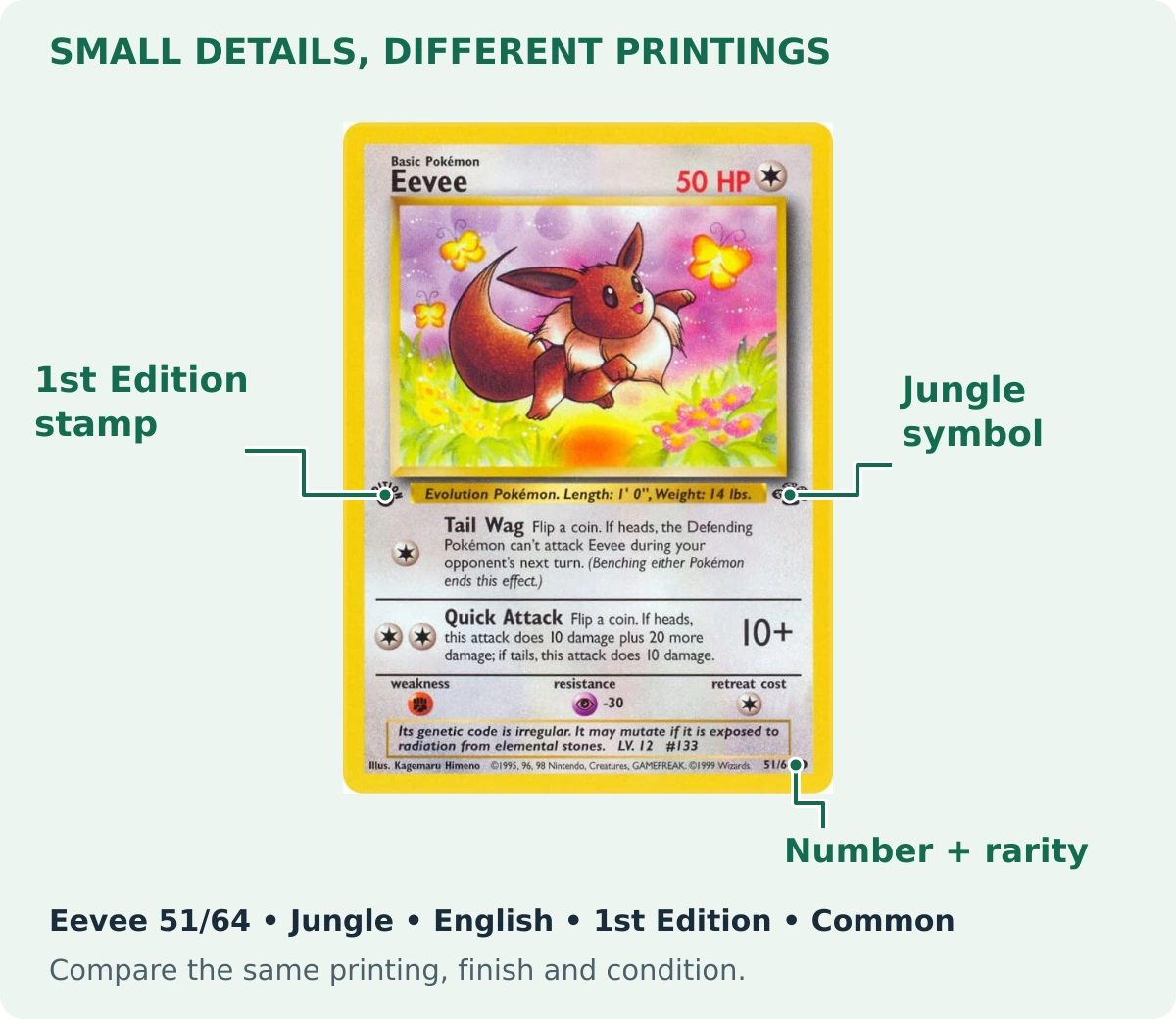
Before assuming an old non-holo is ordinary bulk, check:
- Set and collector number: identify the release rather than relying on the Pokémon or border colour.
- Edition stamp: compare a stamped card with the same edition, not an unstamped copy.
- Print and finish: Shadowless, reverse holo and other documented versions need their own comparisons.
- Condition: creases, surface damage and worn edges can change what someone will pay.
Age is a reason to investigate, not a guarantee of a high price. The same goes for a stamp: it identifies something to research, not an automatic jackpot. Our 1st Edition Machamp guide is a useful example of why the story behind a printing matters.
Does “Basic” at the top mean it is common?
No. Basic describes the Pokémon's evolution stage. It does not tell you the rarity, finish or price. The two English 151 Pikachu cards below both say Basic, but one is a Common and the other is an Illustration Rare.
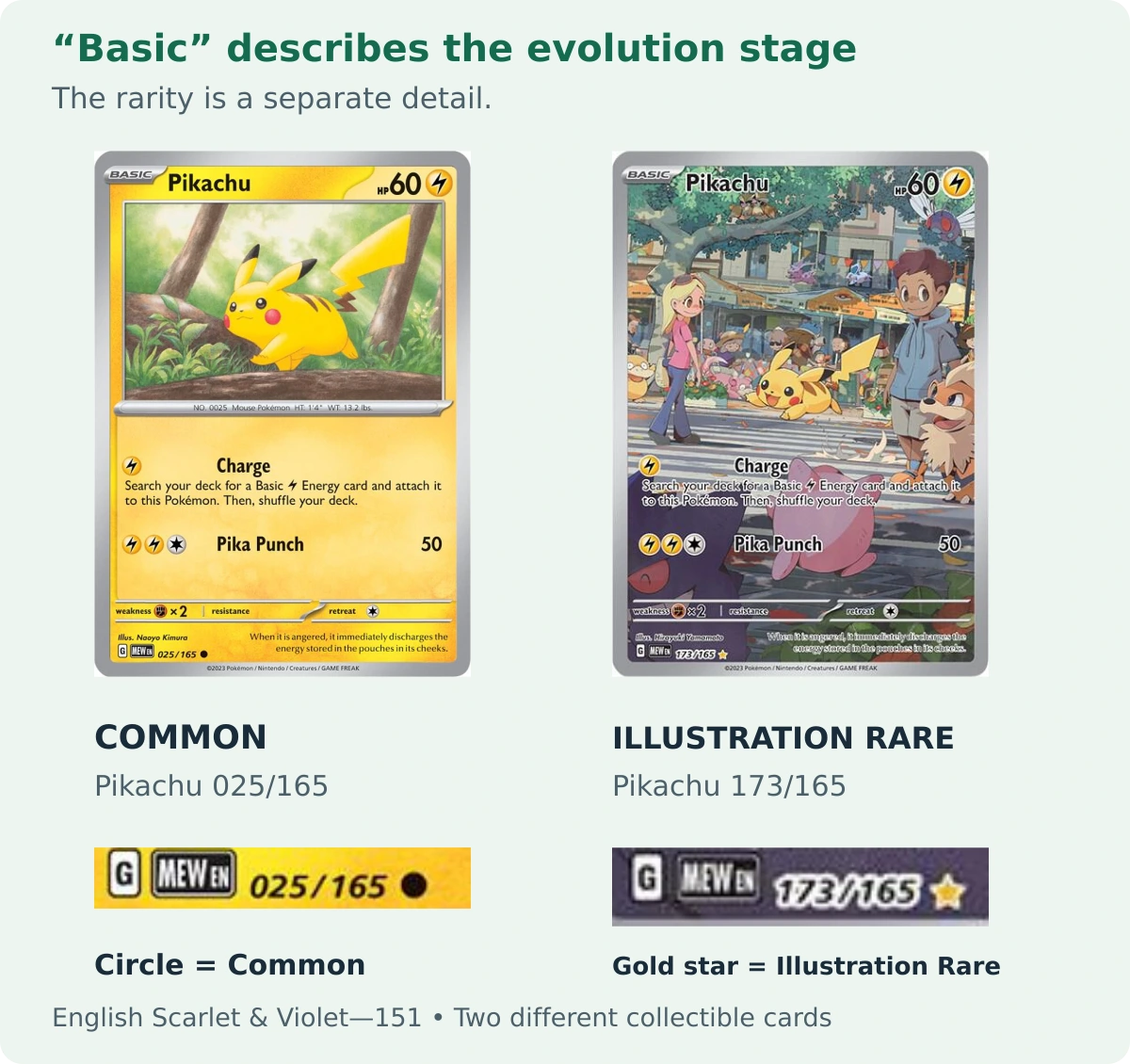
The Illustration Rare is a separate collectible with a different number and artwork. Its value does not mean every card labelled Basic is expensive, and it should not be used to price the ordinary Common version.
Follow the 151 card list to compare the two. If you enjoy the artwork, that can also be a good reason to collect the more affordable version rather than chasing whichever card costs the most.
What can make a common or uncommon worth more?
A particular printing
First editions, some early printings, documented stamps and set-specific finishes can have their own collectors. Match the exact version before applying a price you found online. A stock image alone may not prove which finish or edition a seller will send.
Collector demand
Someone completing a set or collecting every Eevee may want a card that another person overlooks. Artwork, favourite Pokémon and nostalgia can matter alongside rarity. The Jungle Eevee and Team Rocket Dark Dragonair above are examples to identify individually, rather than treating all yellow-border non-holos as interchangeable.
Use in a deck
A useful Trainer, Energy or Pokémon can attract players even without elaborate artwork. Demand can change with reprints and tournament formats, so check current prices for that exact card rather than assuming a once-popular card still commands a premium.
Condition
A clean vintage card and a creased copy may appeal to different buyers. Inspect the front and back under good light, especially corners, edges and the surface. Do not compare a worn ungraded card with a professionally graded Gem Mint example.
A practical way to sort a box of ordinary cards
- Pull out cards you cannot confidently identify. Set aside older cards, unusual stamps, unexpected finishes and anything you want to research.
- Read the name, number and set. Note the language and exact edition or finish as well.
- Check condition before comparing prices. Use an ungraded comparison for an ungraded card, then look for sales of copies in similar condition.
- Decide what deserves an individual listing. A card can have a retail price without being worth your time to sell separately. Fees and the work involved matter.
- Group the remaining cards usefully. Set bundles, Pokémon collections or accurately described bulk lots may make more sense than listing every low-value card alone.
Avoid destructive “tests” such as ripping, bending or soaking a card to decide what it is. Good photos and correct identification should come first.
Protect cards you want to keep with our sleeving guide. For a broader look at valuable categories, read which Pokémon cards are worth money.
Should you grade basic-looking Pokémon cards?
Sometimes, but a Common symbol or an old copyright date is not enough reason to submit a card. Compare the raw value, likely condition, grading costs and realistic graded sale prices. A high advertised PSA 10 price is not evidence that your copy will receive that grade or sell for that amount.
Many inexpensive cards are better enjoyed in a binder. Use our guide to deciding whether a card is worth grading before paying for a submission.
Frequently asked questions
Are non-holo Pokémon cards worth anything?
Some are. The vintage Common and Uncommon examples above are non-holo printings with individual market references. Many ordinary modern non-holos have a small individual value. Identify the exact set, printing and condition before deciding.
Are all cards from Base Set valuable?
No. Values vary by card, printing and condition. Base Set contains different rarities, and a familiar Pokémon does not make every version equally desirable.
Does the circle mean my Pokémon card is worthless?
No. The circle marks Common rarity. It does not account for edition, finish, condition or collector demand.
Are Basic Energy cards worth money?
Ordinary Basic Energy cards are a different category from Basic Pokémon. Identify the actual release and printing: a special version should not be valued as an ordinary copy, and an ordinary one should not inherit a special version's price.
Can I sell a pile of commons for the total of their online prices?
Not necessarily. Individual retail prices, completed-sale prices and a buyer's offer for a whole lot are different things. Check for standout cards first, then describe the remaining lot accurately.
The useful habit is to check before dismissing. Most ordinary cards will not be hidden treasures, but you do not need a full-art card or a shiny surface for a Pokémon card to deserve a closer look.
Build confidence identifying cards and versions in the free OG Cards Academy.