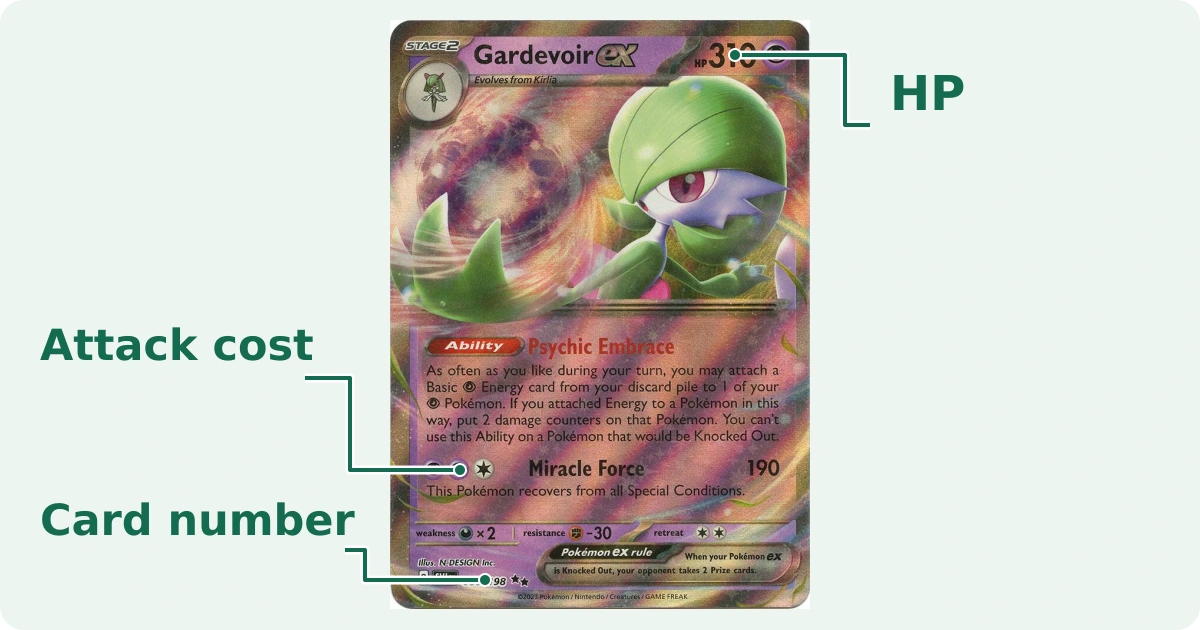
To read a Pokémon card, start with its name, evolution stage, HP and type at the top. Read the Ability and attacks in the middle, then check the bottom for Weakness, Resistance, Retreat Cost, set information, card number and rarity.
You do not need to memorise every symbol at once. Use the numbered card below to find the part you are looking at, then follow the explanation. If you mainly collect, pay particular attention to the small details along the bottom: they help you identify exactly which card you own.
A Pokémon card, labelled from top to bottom
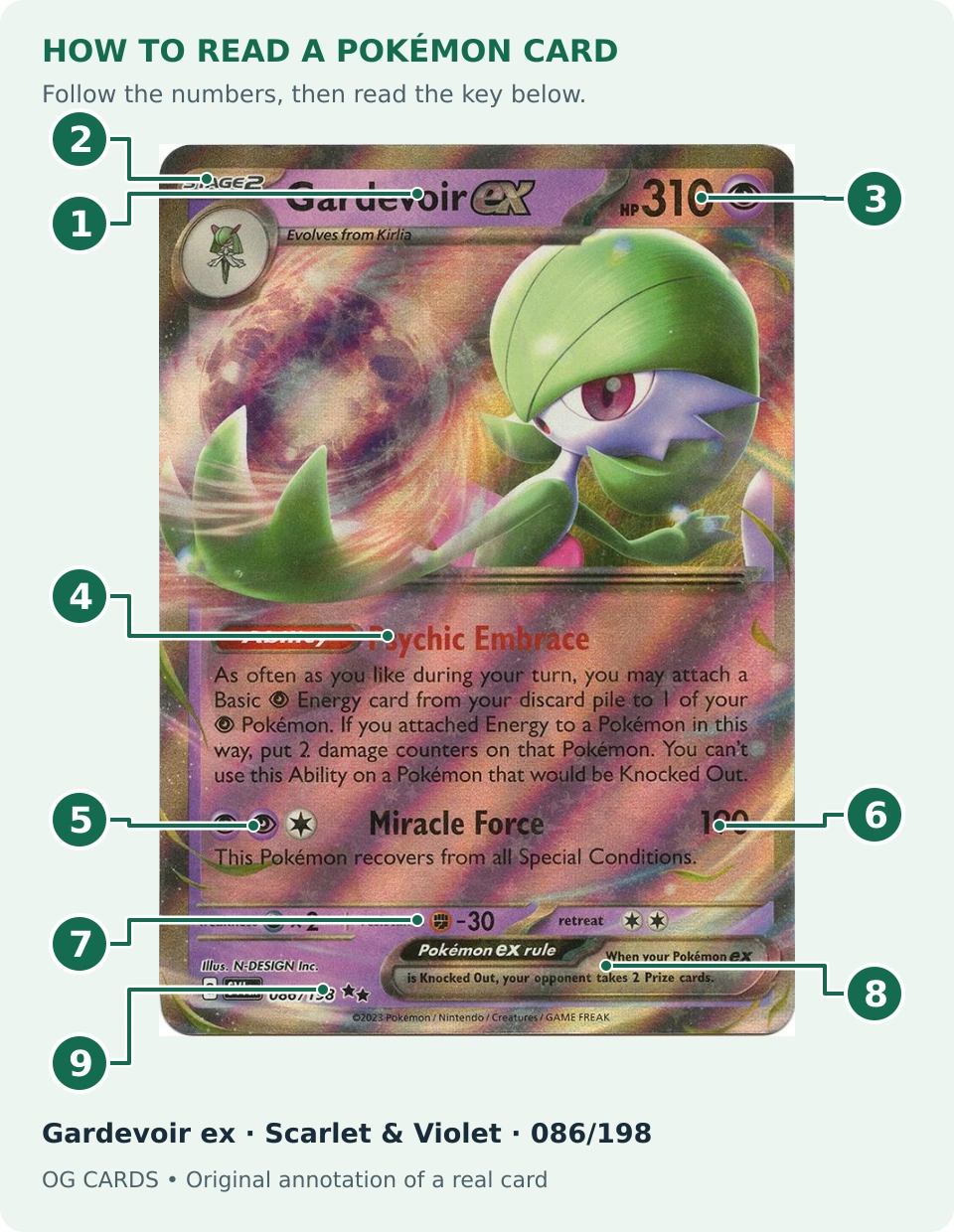
- Name and special label: Gardevoir ex identifies the Pokémon and its ex designation.
- Evolution stage: Stage 2; the card evolves from Kirlia.
- HP and type: 310 HP and the Psychic-type symbol.
- Ability: Psychic Embrace, followed by the instructions for using it.
- Attack cost: two Psychic Energy and one Colorless Energy requirement.
- Attack and damage: Miracle Force, its 190 damage and an additional effect underneath.
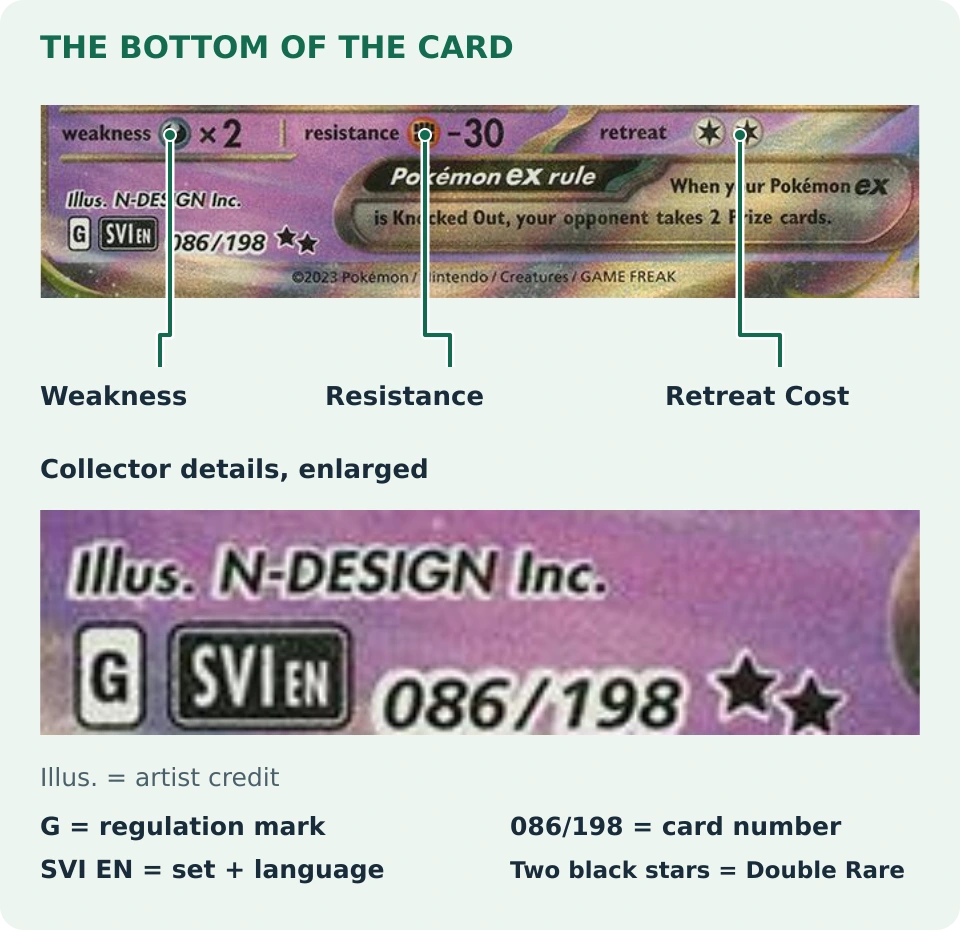
- Weakness, Resistance and Retreat Cost: how this Pokémon takes certain damage and retreats.
- Rule box: the extra Prize-card rule for this Pokémon ex.
- Collector details: illustrator, regulation mark, set code, language, card number and rarity.
1. Read the name, evolution stage, HP and type
Name and labels such as ex, V or GX
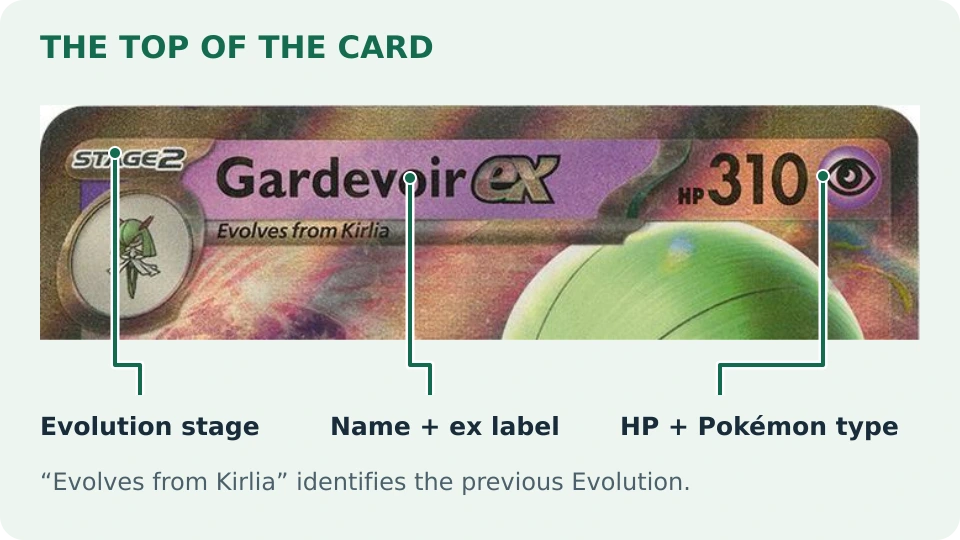
The large name is the first thing to read. Labels such as ex, EX, V, VMAX and GX are part of particular card mechanics, not interchangeable ways of saying a card is rare. Read the rule box on that specific card.
Our example is Gardevoir ex. That label does not tell you its evolution stage: some Pokémon ex are Basic, while this one is Stage 2. It also does not identify the exact collectible printing. Several Gardevoir ex cards can share a name and attacks while having different artwork, numbers or finishes.
Basic, Stage 1 and Stage 2
The evolution label usually sits near the top-left corner. Basic Pokémon can enter play without evolving from another Pokémon. A Stage 1 normally evolves from the named Basic Pokémon, and a Stage 2 normally evolves from the named Stage 1. Some card effects provide exceptions.
Look at the “Evolves from” line, rather than guessing from the artwork. On Gardevoir ex, it names Kirlia. Basic is a gameplay stage, not the same thing as Common rarity.
HP and the type symbol
HP means Hit Points. Gardevoir ex has 310 HP. In ordinary play, it is Knocked Out when the damage on it reaches or exceeds that amount. Printed HP stays the same as damage builds up; players track damage separately.
The symbol beside the HP shows the Pokémon's TCG type. Here, the purple eye symbol means Psychic. The type tells you about gameplay, not the card's price. A large HP number alone is not evidence that a card is valuable or genuine.
2. Read the Ability and attack properly
An Ability is separate from an attack
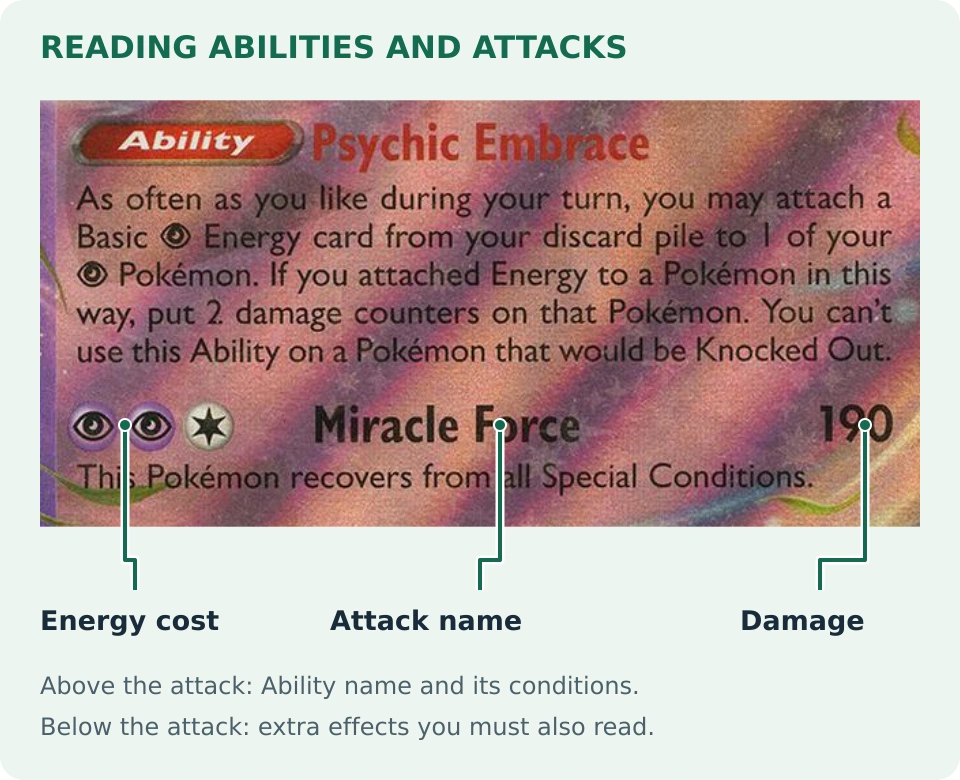
An Ability has its own label and instructions. It does not use up your attack just because you use it. Its text tells you when it works, whether you choose to use it and how often it can be used. Some Abilities apply continuously; others have conditions or once-per-turn limits.
Psychic Embrace is an Energy-attachment Ability with a damage-counter consequence and a restriction that prevents it Knocking Out the recipient. That detail matters: reading only the Ability's name would miss how it actually works. Other Pokémon may have no Ability at all.
The symbols on the left are the attack's Energy cost
Miracle Force shows two Psychic symbols and one Colorless symbol. The Pokémon needs Energy attached that supplies those requirements before it can use the attack.
A Colorless requirement can be met with any Energy type. Three Basic Psychic Energy cards would work here. So would two Basic Psychic Energy cards plus one Basic Water Energy card. One Psychic and two Water would not meet the two Psychic requirements.
The star in an attack cost is not a rarity star. Its location matters: beside an attack, it means a Colorless Energy requirement. Beside the collector number, stars can indicate rarity.
You normally keep the attached Energy after attacking. Discard it only when an attack or another rule or effect tells you to. Retreating has its own Energy-discard cost. Some Special Energy cards provide more than one Energy, so count what the attached cards supply, rather than simply counting cards.
The number on the right is attack damage
Miracle Force has a printed damage number of 190. Its text also removes Special Conditions from this Pokémon. That is an additional effect; it does not mean healing all damage.
Other attacks may show a plus sign, a multiplication sign or no damage number at all. Read the text to find out what changes the damage or what the attack does instead. Weakness, Resistance and other effects can also change the final result.
3. Check Weakness, Resistance, Retreat Cost and the rule box
These details sit near the bottom of many Pokémon cards. They refer to different actions, even though they reuse familiar type and Energy symbols.
- Weakness: Gardevoir ex shows Darkness ×2. Ignoring other effects, an attack from a Darkness-type Pokémon that would do 100 damage does 200 instead.
- Resistance: it shows Fighting −30. Ignoring other effects, an attack from a Fighting-type Pokémon that would do 100 damage does 70 instead. A blank Resistance field means no printed Resistance.
- Retreat Cost: its two Colorless symbols mean discarding two Energy worth of attached Energy to retreat normally to a Benched Pokémon. Any Energy type can meet that cost. You normally retreat once per turn, and effects or Special Conditions can change what is possible.
Weakness and Resistance concern attack damage. An effect that places damage counters is different; do not automatically double those counters for Weakness.
The Pokémon ex rule box on this Gardevoir says the opponent takes two Prize cards when it is Knocked Out. Other card mechanics can have different rules, including different Prize-card penalties, so check the actual box rather than assuming every special Pokémon works the same way.
4. Decode the set, card number, rarity and small print
Set symbol or set code
A set is the expansion a card belongs to. Many older English cards use a small picture symbol; Scarlet & Violet-era English cards use a short printed set code. Our example has SVI, identifying Scarlet & Violet Base Set.
EN beside it indicates English. Match the language as well as the set and number when comparing cards. A Japanese release can have a different set code, card list and rarity system, even when the artwork looks familiar.
The two numbers separated by a slash
086/198 means card 86 in a set whose printed main numbering runs to 198. The leading zero does not change the number. The denominator is not the number of physical copies printed, and it does not necessarily include every additional card or variation in the release.
A card can have a number higher than the denominator. For example, Pikachu 173/165 from Pokémon 151 sits beyond the main 165-card numbering. That alone does not make it an error or fake. Check its specific rarity and printing. Promo cards may instead use their own numbering, without the same slash format.
Rarity symbols
Look beside the collector number. The basic symbols are a circle for Common, diamond for Uncommon and black star for Rare. In Scarlet & Violet-era English sets, additional examples include:
- Two black stars: Double Rare, as on this Gardevoir ex.
- Two silver stars: Ultra Rare.
- One gold star: Illustration Rare.
- Two gold stars: Special Illustration Rare.
- Three gold stars: Hyper Rare.
This is not every rarity from every era. Special releases, promos and different languages can use other markings. Rarity and foil finish are also separate details: a Common card may have a reverse-holo version. Our reverse-holo guide explains why identifying that finish matters.
The letter in a box: regulation mark
The G on this example is a regulation mark used when determining tournament legality. It is not a condition grade, rarity rating or guarantee that the card is currently Standard-legal. Rotation and reprint rules change, so check the current official format rules if you plan to compete. Older cards may have no regulation mark.
Illustrator and copyright
Illus. introduces the illustrator credit: here, N-DESIGN Inc. The copyright line is a legal credit, not a unique card identifier. Neither the artist's name nor the copyright year alone tells you the exact version or its value.
5. What changes on older Pokémon cards?
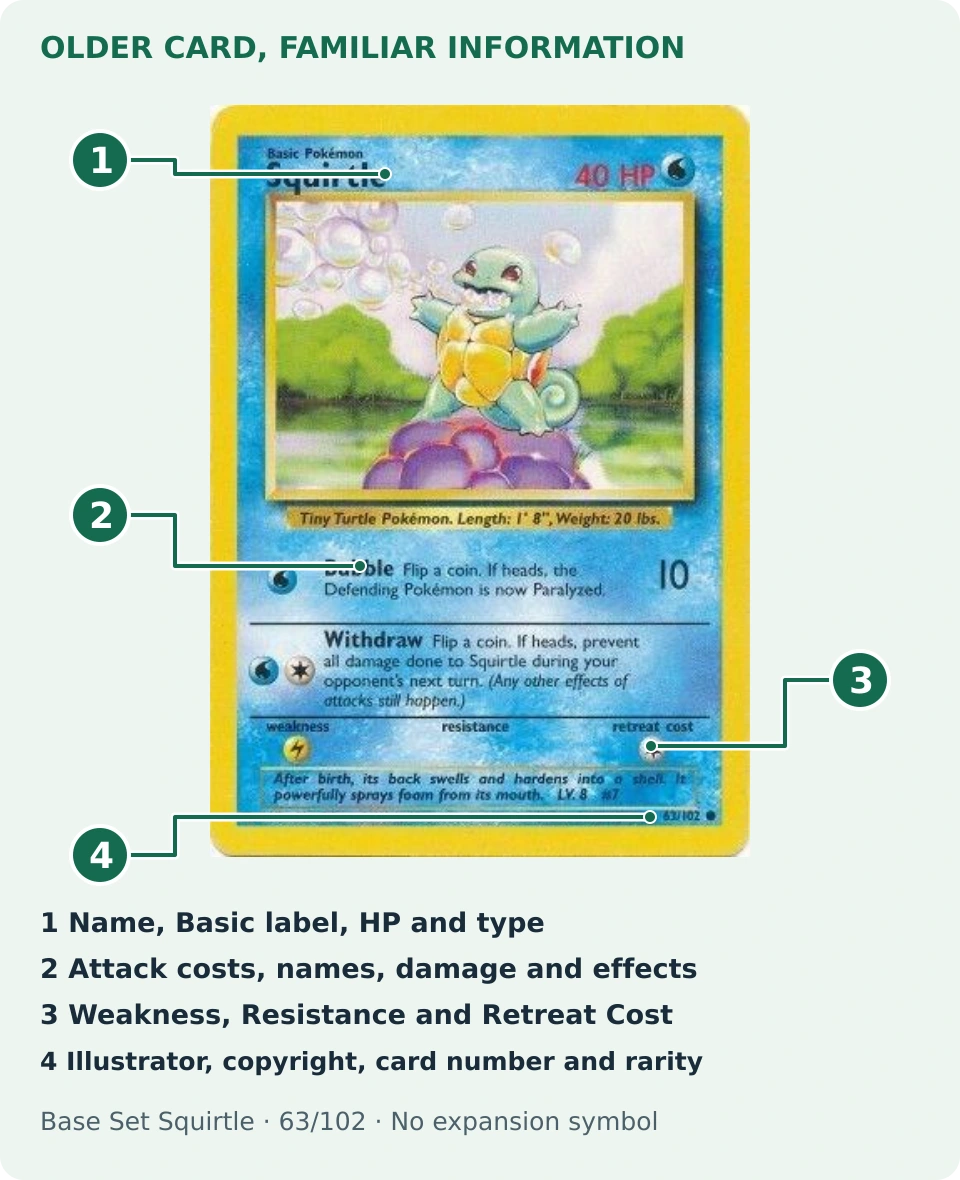
On this Base Set Squirtle, the name and 40 HP are at the top, attacks sit under the artwork, and the collector number 63/102 is at the bottom-right. The nearby circle marks it as Common.
There is no expansion symbol on this ordinary Base Set example and no modern regulation mark. Those absences are expected. The artwork has a framed picture, while Gardevoir ex extends the artwork across more of the card.
Older cards can also show labels such as Pokémon Power or a Pokémon's level. Read the wording for that era. A Pokémon's species number or level is different from its collector number; use the set and collector number when identifying the printing.
6. What about Trainer and Energy cards?
Trainer cards identify their category, such as Item, Supporter, Stadium or Pokémon Tool. Read the effect and any category rule printed on them. They do not follow a Pokémon's HP-and-attacks layout.
Energy cards supply Energy. Basic Energy cards prominently show an Energy type; Special Energy cards have text explaining what they provide and any conditions. Basic Energy cards commonly lack the rarity marking you would expect on a Pokémon card.
The set information and numbering that are present still help identify the card, but do not assume every Trainer or Energy card has every field shown on our Pokémon example.
A quick checklist for identifying your own card
Pick up a card and note these details before searching for it:
- Name: include labels such as ex or V.
- Collector number: copy the full number, including the denominator or promo prefix.
- Set: match the set code or expansion symbol.
- Language: do not assume matching artwork means the same release.
- Version: check foil finish, stamps and edition details.
Our main example becomes Gardevoir ex — Scarlet & Violet — 086/198 — English. That is much more useful than searching only “Gardevoir card”. Then match the artwork and any stamps to confirm the printing. You can explore the set in our Scarlet & Violet card list.
Reading those details is the first step towards valuing a card. Condition and the exact version still matter; our guide to Pokémon cards worth money covers what to check next.
Common questions about reading Pokémon cards
Does Basic mean a Pokémon card is common or worthless?
No. Basic describes its evolution stage. Check the separate rarity mark, exact printing and condition. A Basic Pokémon can appear on a highly collectible card.
Does higher HP mean a card is worth more?
No. HP is a gameplay statistic. Collector demand, availability, condition and the specific printing affect value; HP is not a price scale.
Does a number such as 173/165 mean the card is fake?
No. Some genuine cards are numbered beyond their set's main numbering. Compare the exact card with a reliable set list; an unusual number alone does not establish authenticity.
Can I tell holo and reverse holo from the rarity symbol?
Not reliably. The same rarity and collector number can appear with different finishes. Examine where the foil appears and compare the exact printing.
Can I read a Japanese Pokémon card the same way?
You can locate familiar elements such as HP, attack costs and damage, but rarity codes, set numbering and printed text differ. Use a reliable translation to understand effects; do not guess from an English card's artwork.
Want to practise identifying cards and versions? Start the free OG Cards Academy and build on what you have learned here.
Card images depict the original Pokémon cards; annotations by OG CARDS.