This Charizard is a counterfeit presented in an imitation PSA slab—not a genuine PSA 10 1st Edition Charizard. This guide explains what gives the reproduction away: the foil effect outside the artwork, thin borders, incorrect card printing and colour, and imitation PSA labels.
The copied PSA branding, 1st Edition stamp and small plastic marks do not make it genuine. Those are precisely the details that can reassure a buyer who has not yet looked closely at the card itself.
Fake card; unknown seller intent. These are separate questions. The screenshots do not establish whether the seller knew the item was counterfeit or had themselves been misled. Their identity is withheld.
What gives this fake PSA Charizard away?
The listing claims a 1999 English 1st Edition Charizard in PSA 10. Start with the physical reproduction, then look at the listing details that can distract buyers.
1. The foil effect extends outside the artwork window
The holo area on this Base Set Charizard should be the rectangular artwork window—not the whole card face. The whole-card foil appearance in this counterfeit extends into areas that should have ordinary printed surfaces, including the surrounding border and text area.
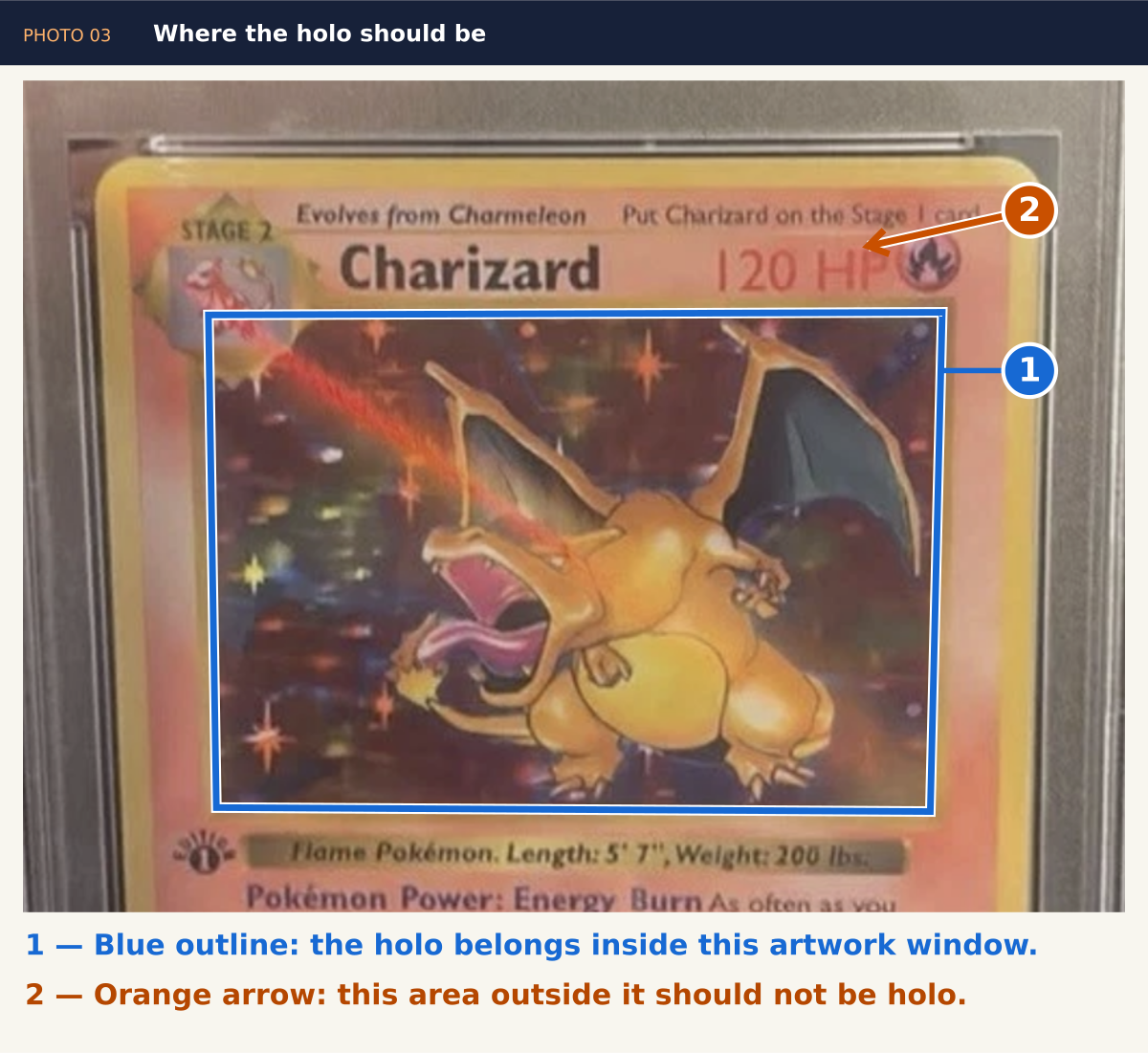
This is more specific than saying “glare means fake.” A plastic holder can reflect light across a genuine card. The tell being highlighted here is the foil-like finish across the reproduced card face, rather than a reflection on the slab. View the full front in the next photograph alongside this close-up.
For other listings, request a tilt video to separate reflections on the plastic from the card’s finish. These still photographs do not demonstrate movement, so we are not claiming to have tested how this particular foil changes with angle. Star shapes alone are not proof either: genuine Base Set holo patterns include stars. CGC has even documented a different fake Charizard made using genuine holo material beneath counterfeit printing.
2. The yellow borders and card proportions are wrong
The yellow perimeter is too thin around this reproduction. The enlarged-looking design leaves narrow outer borders. Look at the relationship between the outer edge, artwork and text, as well as the foil appearance outside the image window.
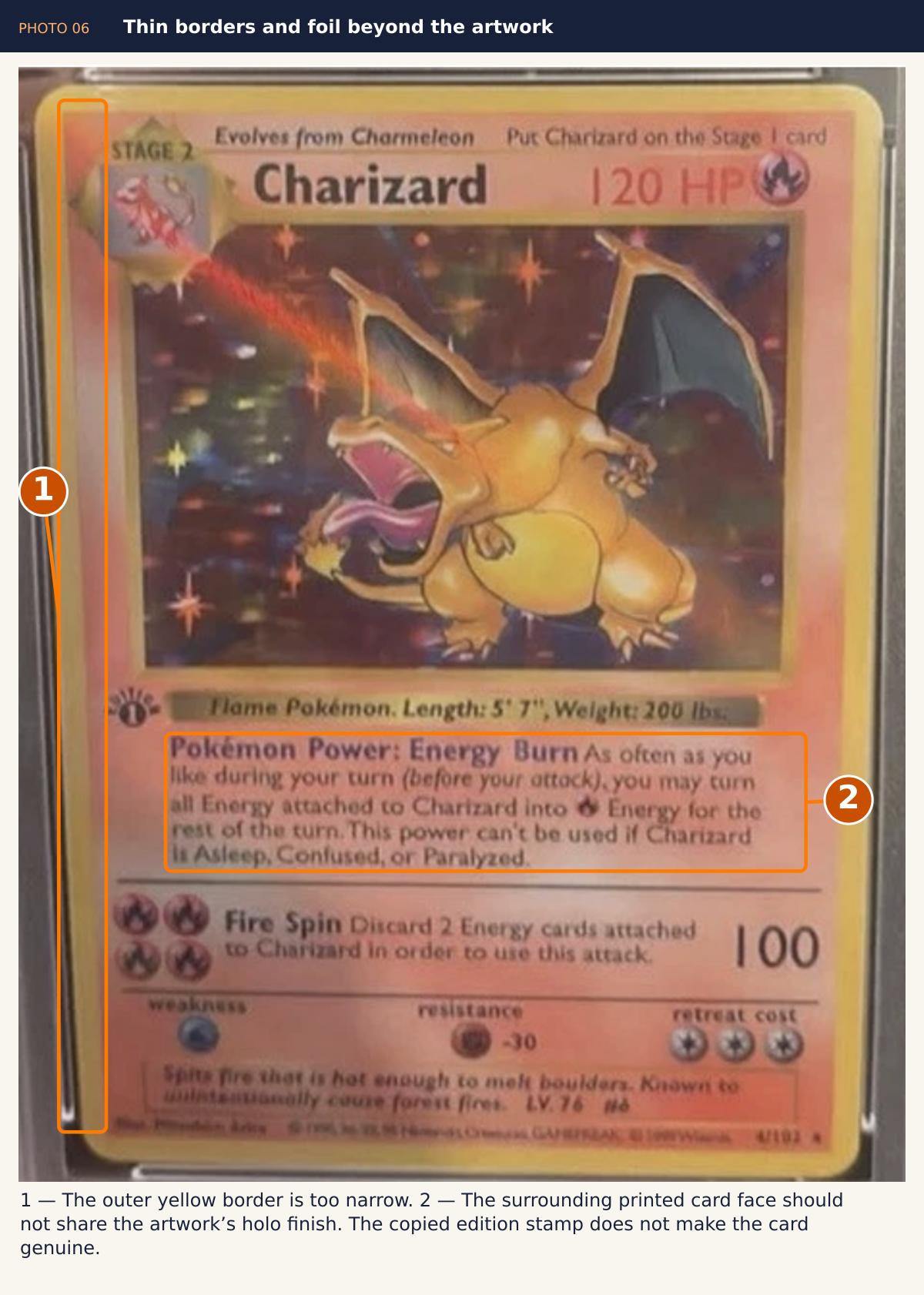
A genuine off-centre card may have a narrow border on one side and a wider one opposite. That is different from incorrect proportions across a reproduced design. Here, the border problem accompanies the wrong finish, printing and colour.
The 1st Edition stamp is copied too. It does not turn a reproduction into an original. For English Base Set Charizard, the stamp must be on a card with the correct shadowless printing, typography and layout. Do not apply this Base Set-specific rule to every expansion.
3. The front label has incorrect typography and imitation foil
The label is an imitation, not evidence of a PSA 10 grade. Notice the letter shapes, weight and spacing in “POKEMON GAME” and “CHARIZARD,” and the presentation of “GEM MT” and “10.” The text and foil treatment do not correctly reproduce the PSA label being imitated.
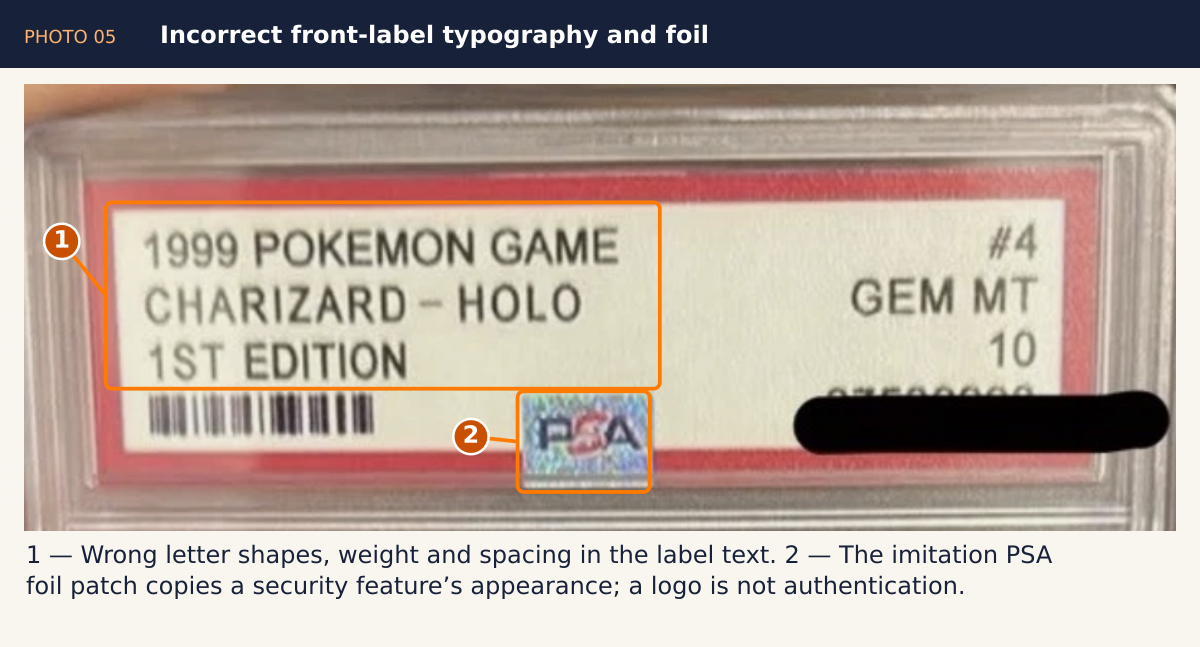
The shiny central PSA patch copies the appearance of a security feature. A logo on reflective material is not authentication. PSA’s LightHouse guidance describes an angle-dependent illumination effect; a still photograph of a logo does not demonstrate that effect.
When checking another slab, compare the appropriate label generation. PSA has changed its designs. An older authentic label should not be rejected simply because it differs from a current one; incorrect reproduction is the issue here.
4. The rear label also copies PSA branding incorrectly
The rear logo treatment, background printing and central foil feature are further parts of the imitation. Checking only the red front label misses another view of the counterfeit.
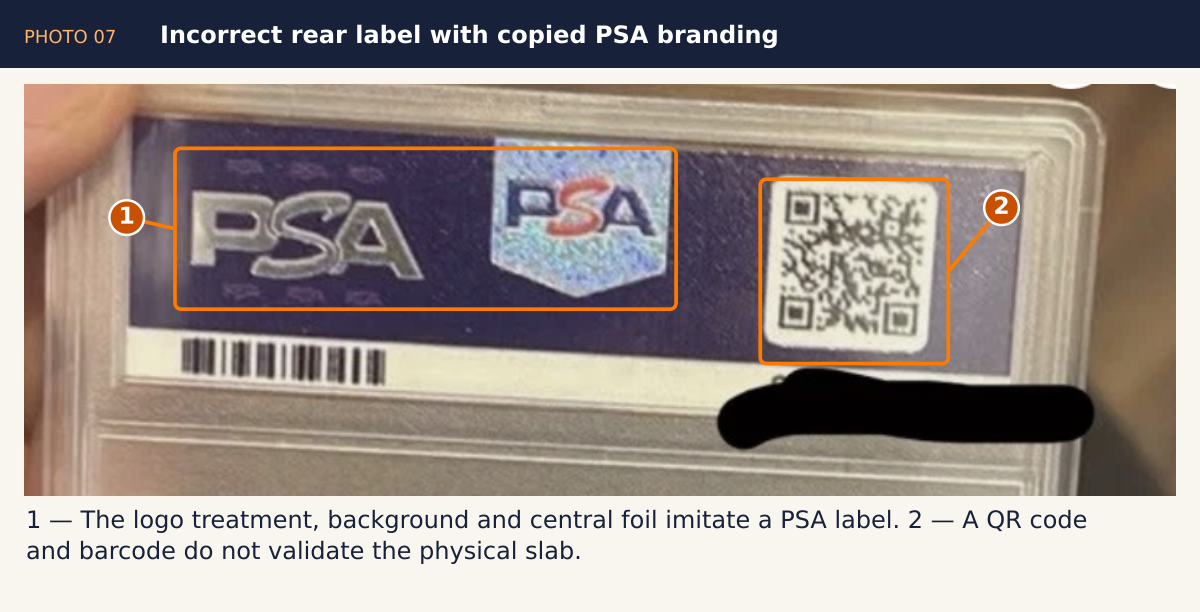
A QR code or barcode cannot override a fake card and label. PSA warns that counterfeit labels can use certification numbers copied from genuine records. A successful lookup establishes that a record exists, not that the physical slab is that item.
The number in these screenshots is obscured. We have not verified it and are not claiming this particular number was copied, invalid or deactivated.
5. The back colour and print reproduction are wrong
The incorrect blue border and washed-out reproduction of the back add to the mismatches. Look at the logo outlines, swirl, Poké Ball and the distinction between the outer border and inner design. The problem is the reproduced back as a whole.
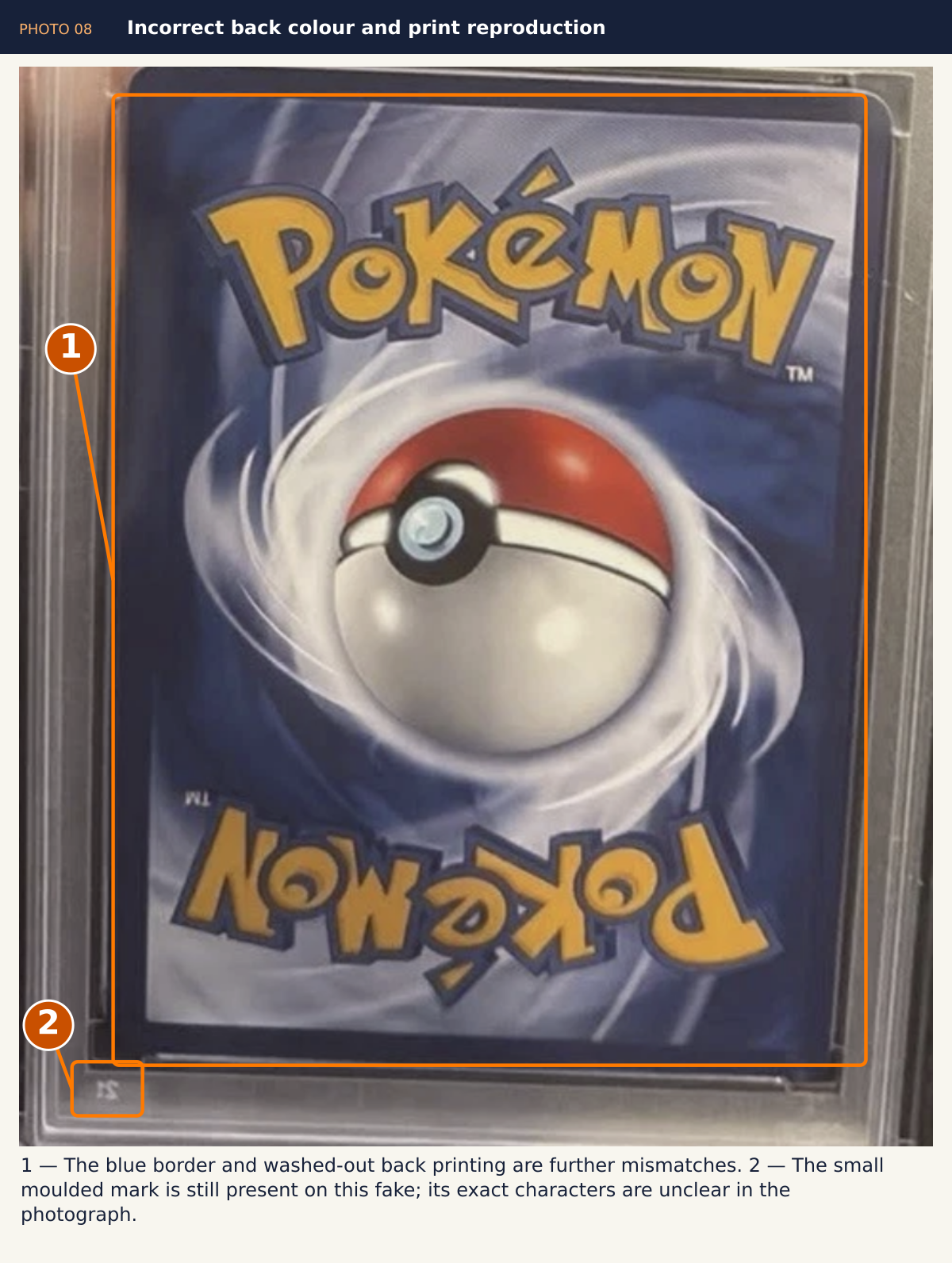
For a different listing, account for lighting and white balance before relying on colour. In this example, the back-printing problem accompanies the wrong front proportions and imitation labels; it is not a verdict based on one shade of blue.
6. The fake still includes familiar-looking plastic marks
Counterfeit holders can imitate the small details buyers expect. Familiar-looking corner marks are present here despite the counterfeit card and labels. “It has a PSA logo” or “it has the little number” is not an authentication test.
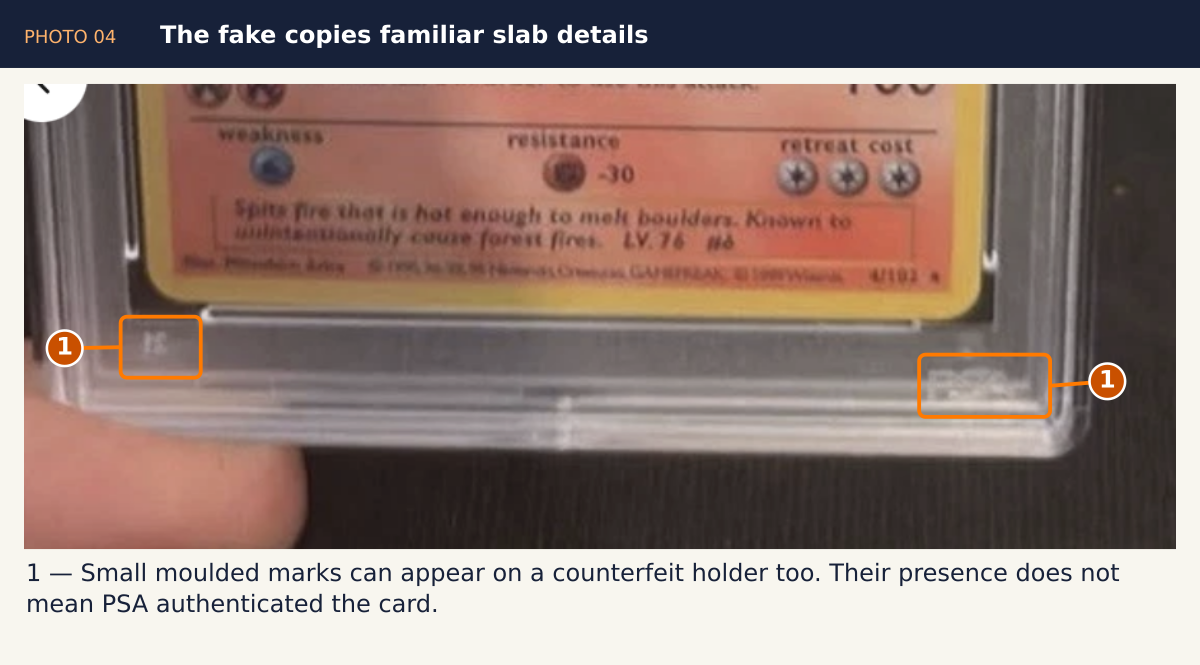
The rear mark was described by the screenshot provider as “21.” Its exact characters are too soft to confirm in the original image. The lesson is that a small moulded mark can still appear on a fake—not that one particular mould number guarantees authenticity.
For other slabs, inspect the seams and corners as well as the labels and card. PSA describes its holders as tamper-evident. Do not pry, bend or crack a slab to test it, and do not mistake ordinary scratches for proof of tampering.
How the listing makes the counterfeit look convincing
7. A grail-card title and PSA 10 claim borrow credibility
The title advertises a 1st Edition Charizard in PSA 10. Those words are the listing’s claim. The counterfeit’s grading presentation borrows the appearance of a genuine high-value collectible.
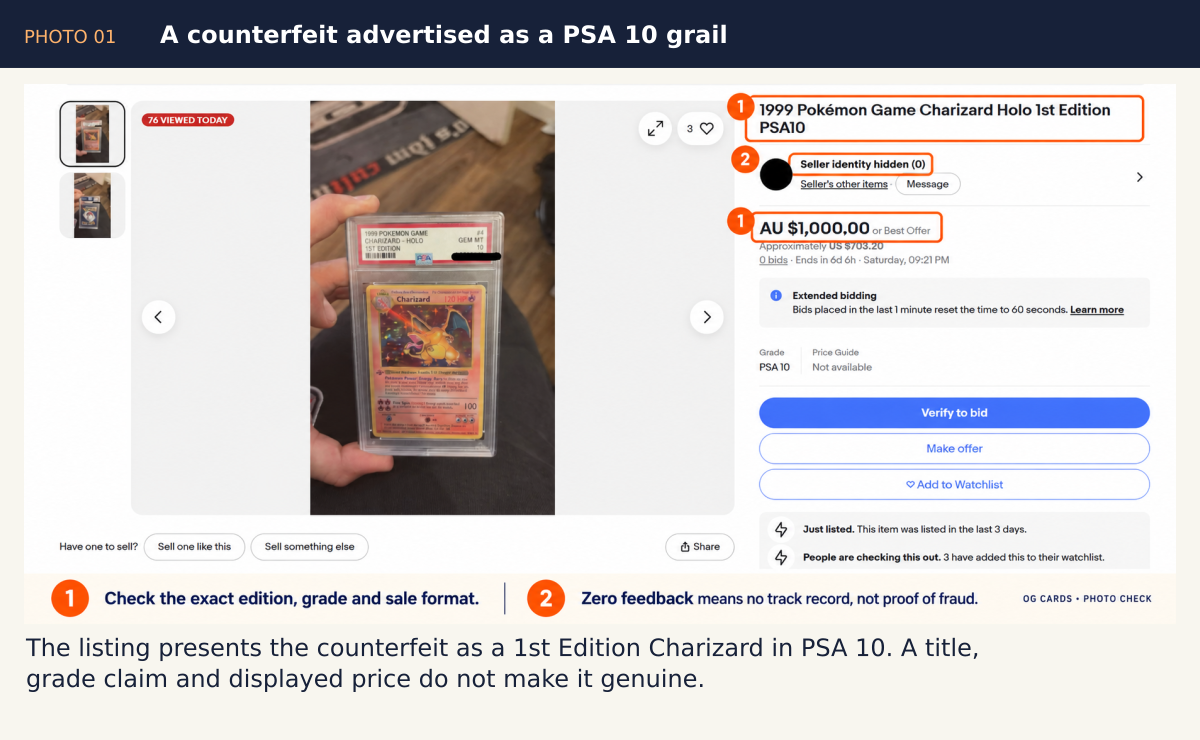
The screenshot shows AU$1,000, zero bids and several days remaining, alongside an offer option. That is an unfinished listing, not a completed sale or a reliable valuation. A low auction starting price is not what makes the card fake; the physical discrepancies are.
8. Zero feedback is a separate buying risk
Zero feedback leaves no established feedback record to assess for an expensive purchase. Genuine sellers also start at zero, so it is not evidence of counterfeit printing or deliberate fraud.
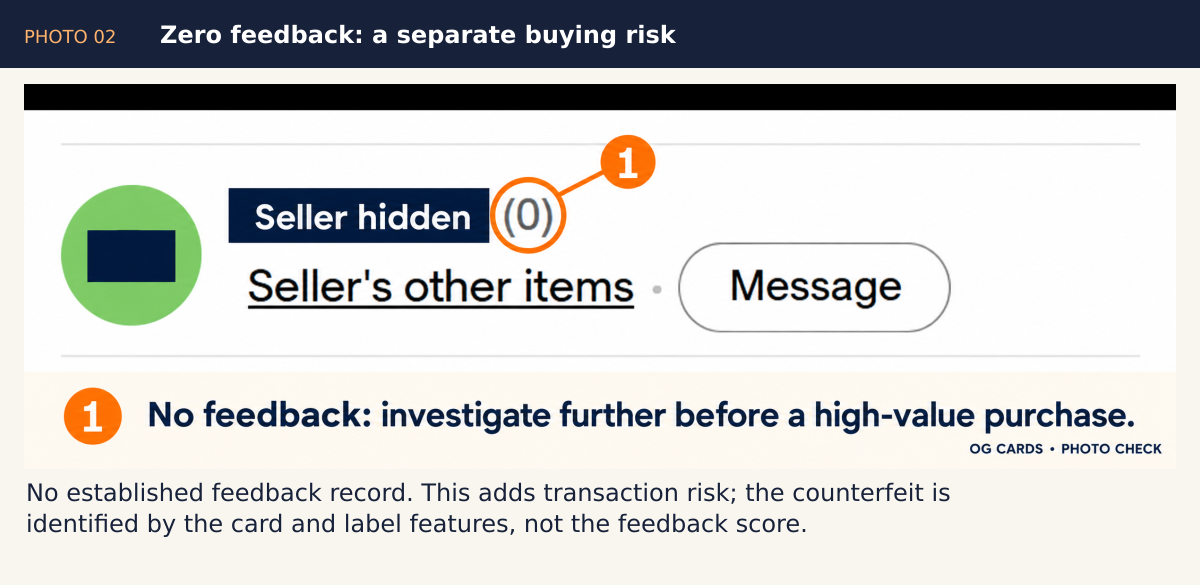
This counterfeit would still be counterfeit on an account with excellent feedback. Equally, a new seller can own a genuine card.
9. Account age does not authenticate the item
The profile says “Joined Nov 2023” and “No feedback yet.” An older account may have no meaningful selling history. A response-time badge describes communication, not expertise or card authenticity.
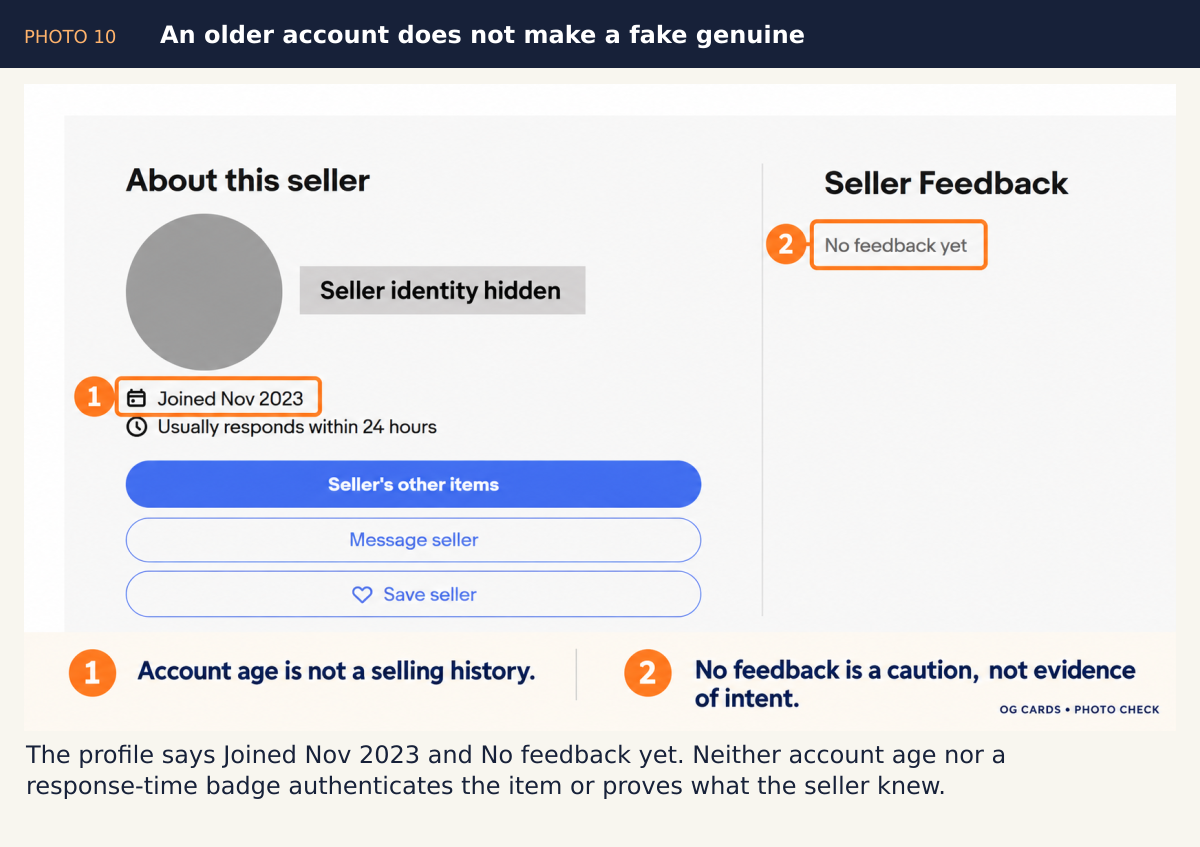
For future purchases, fresh photographs with a handwritten date or agreed word can help establish access to the item. They still do not make a counterfeit genuine.
10. Confident sales language cannot fix a fake
The description claims a perfect PSA grade and authenticity, while offering extra photos and a certificate number. Those claims are contradicted by the counterfeit card and imitation labels.
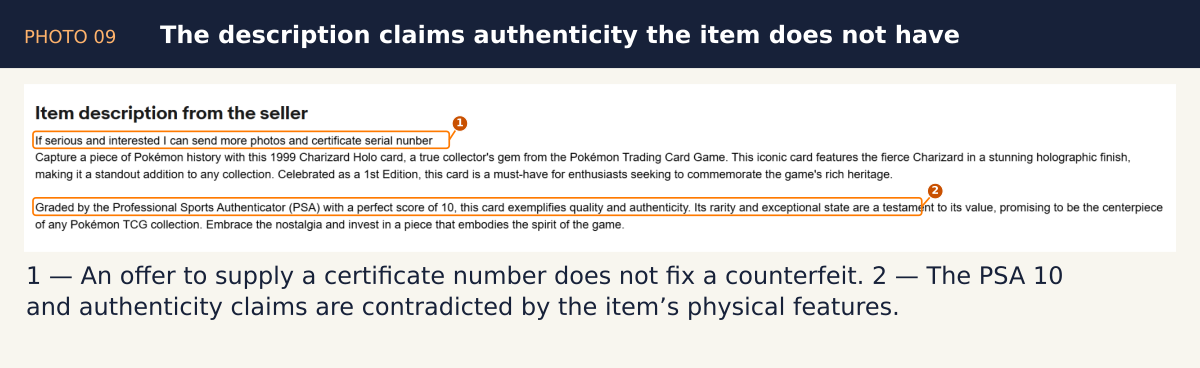
A description can be written, copied or generated. Its enthusiastic tone is not the proof of a fake; the item is. It also does not establish what the seller knew. Focus on the physical discrepancies and unsupported claims rather than speculating about intent.
Before-you-pay checklist for another listing
- Identify the printing: card, language, set, number, edition and claimed grade.
- Inspect the card: border proportions, print, typography, back and where the holo belongs.
- Inspect both labels: compare authentic examples of the appropriate holder generation.
- Verify the certificate independently: enter it through PSA’s official service and compare available scans. A matching number is insufficient on its own.
- Request useful images: front, back, both labels, slab edges and a tilt video.
- Assess the purchase: relevant selling feedback, completed sales and protections shown on the actual listing.
- Do not let copied details outweigh defects: logos, numbers and stamps cannot make counterfeit printing genuine.
Does eBay Authenticity Guarantee cover every PSA card?
No. Eligibility depends on the marketplace, item and transaction. Check the actual programme badge and terms for your purchase. Do not assume US rules apply unchanged to an Australian listing, or that a high asking price or PSA claim automatically qualifies it.
The programme includes authentication for eligible purchases; it is not simply a fresh grading service. These screenshots do not establish whether this listing qualifies.
What if you already bought a counterfeit?
Keep the listing, messages, payment record, packaging and clear photographs of what arrived. Follow the marketplace’s applicable help and return process promptly. Do not crack the slab, destroy the item or send it to an address supplied through an informal request.
Contact PSA through its official support channel for guidance on a counterfeit label or holder. Report the observable issues to the marketplace. You can explain that an item is counterfeit without claiming to know the seller’s intent.
Questions about fake PSA Pokémon cards
Is the Charizard in this guide genuine?
No. This is a counterfeit case study. The wrong card finish, proportions, printing, colour and imitation labels are the subject of the annotations. The copied branding is not a reason to treat it as authentic.
Should the whole of a Base Set Charizard be holographic?
No. The intended holo area is the artwork window. Distinguish a foil finish on the card outside that window from an ordinary reflection on the plastic slab. This is not a universal rule for other Pokémon cards, many of which intentionally have different foil treatments.
Can a fake slab have a real certificate number and PSA logos?
Yes. PSA warns that genuine numbers can be copied onto counterfeit labels. Visible logos and mould marks can be imitated too. Check the physical item rather than treating a single familiar feature as proof.
Does zero feedback prove the seller is a scammer?
No. It adds uncertainty about the transaction history. The seller’s knowledge and intent remain separate from the counterfeit item.
Learn the details before buying
Read our guide to reading a Pokémon card, learn what PSA 10 means, or compare PSA, BGS and CGC grading.
Research checked 1 November 2026. The example was supplied and identified as counterfeit by OG CARDS. This commentary examines the supplied photographs; it is not a PSA-issued authentication report, and the obscured certificate was not checked. References include PSA Cert Verification and Security guidance, CGC’s counterfeit Charizard investigation, and eBay programme and counterfeit policies. Card-detail photographs retain their original pixels with separate callouts. Three seller-interface illustrations use AI-assisted anonymisation. Seller identity and existing certificate redactions remain concealed.