How many Pokémon are there?
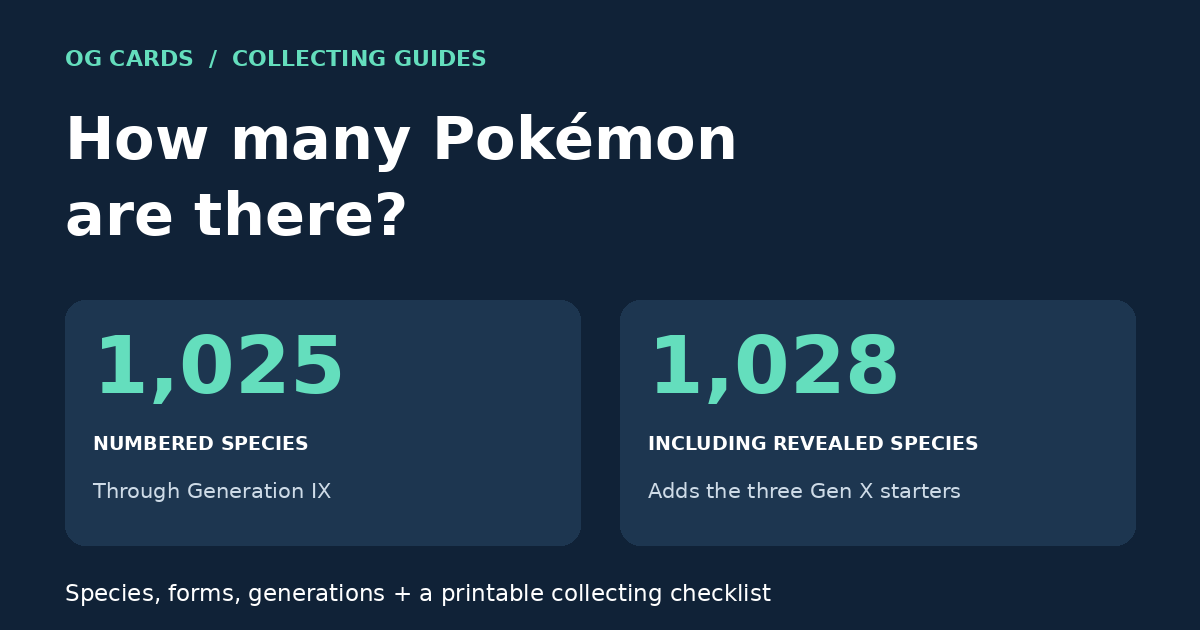
There are 1,025 numbered Pokémon species through Generation IX, or 1,028 known species when you include the three revealed Generation X starters: Browt, Pombon and Gecqua. Those two totals use different cut-offs. Regional forms, Mega Evolutions and shiny colours do not add new species to either count.
The numbered list runs from Bulbasaur, #0001, to Pecharunt, #1025. The three new starters were revealed for Pokémon Winds and Pokémon Waves, scheduled for 2027. We keep them separate from the numbered list rather than give them unofficial Pokédex numbers.
| What you are counting | Total |
|---|---|
| Numbered species through Generation IX | 1,025 |
| Including the three revealed Generation X starters | 1,028 |
| Every form, transformation and colour variation | Depends on which variations you include |
Counts checked on 29 October 2026. The 1,028 figure is the known total at this cut-off, not the final size of Generation X.
Pokémon by generation · What counts as a species? · Download the checklist · Plan a card binder
How many Pokémon are in each generation?
Each generation adds new species to the National Pokédex. The running total includes all earlier generations; it is not the number catchable in a particular game.
| Generation / era | New species | Running total | National numbers |
|---|---|---|---|
| I · Kanto | 151 | 151 | 0001–0151 |
| II · Johto | 100 | 251 | 0152–0251 |
| III · Hoenn | 135 | 386 | 0252–0386 |
| IV · Sinnoh | 107 | 493 | 0387–0493 |
| V · Unova | 156 | 649 | 0494–0649 |
| VI · Kalos | 72 | 721 | 0650–0721 |
| VII · Alola era | 88 | 809 | 0722–0809 |
| VIII · Galar / Hisui | 96 | 905 | 0810–0905 |
| IX · Paldea era | 120 | 1,025 | 0906–1025 |
Generation X has three revealed species so far: Browt, Pombon and Gecqua. Their announcement raises the known-species count to 1,028; it does not make the Generation IX numbered list longer.
Generation VII includes Meltan and Melmetal, introduced through Pokémon GO. Generation VIII includes the new species introduced in Pokémon Legends: Arceus, such as Wyrdeer and Enamorus. A regional Pokédex can contain older Pokémon too, so “Pokémon in the Paldea Pokédex” and “new Pokémon introduced in Generation IX” are different totals.
The original Generation I introduced 151 species, from Bulbasaur to Mew. Generation V introduced the most new species among the completed first nine generations: 156.
What counts as a separate Pokémon?
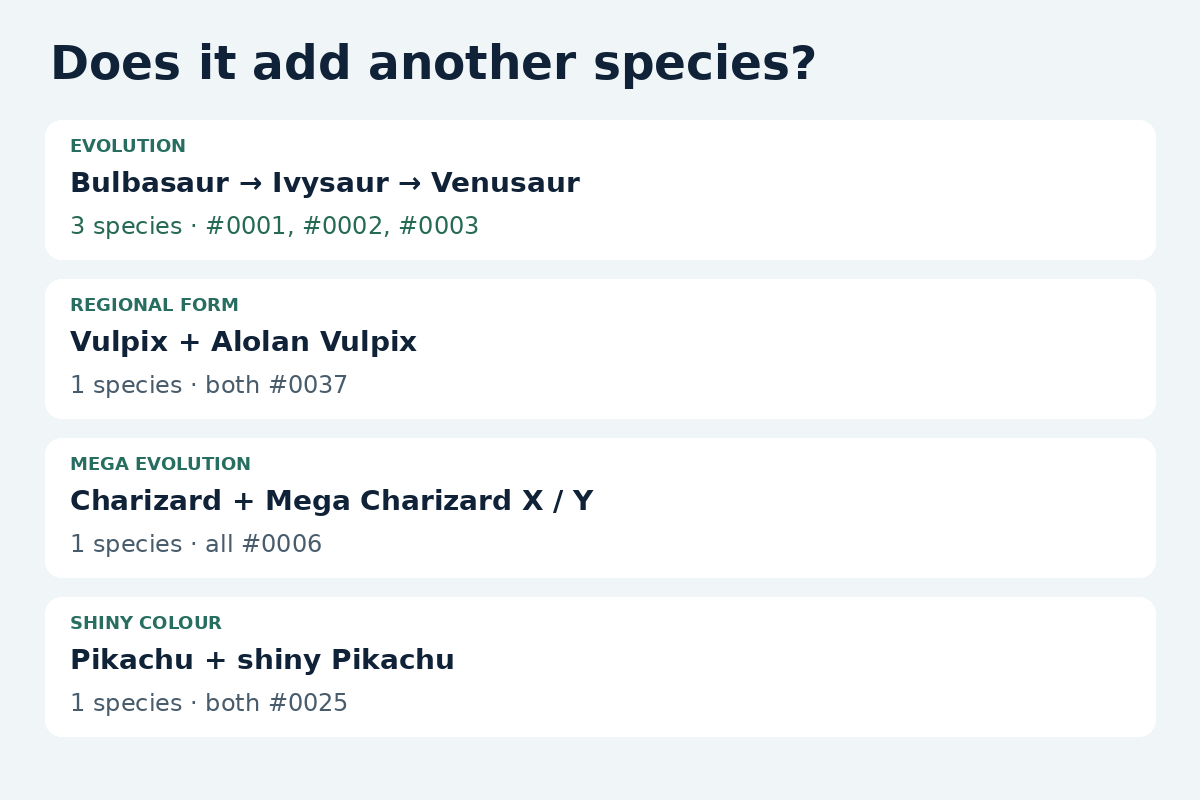
A useful rule is to count each National Pokédex number once. An evolution with its own number adds a species; another form of an existing number does not.
Do evolutions count separately?
Yes. Bulbasaur (#0001), Ivysaur (#0002) and Venusaur (#0003) are three species. The total of 1,025 already includes evolved Pokémon; you do not add them again. Babies such as Pichu also have their own entries.
Do regional forms count separately?
No. Vulpix and Alolan Vulpix both use #0037. They can have different looks and types while remaining one species. But a regional evolution can be a separate species: Galarian Meowth still uses Meowth’s #0052, while its evolution Perrserker has its own number, #0863.
Do Mega Evolutions, Gigantamax and shinies add species?
No. Charizard, Mega Charizard X and Mega Charizard Y share #0006. Gigantamax is another form, and a shiny Pokémon is a colour variation. They can make excellent extra binder pages without changing a one-per-species checklist.
What about Legendary, Mythical and Paradox Pokémon?
They are included when they have their own National Pokédex entries. Mew (#0151), Mewtwo (#0150) and Great Tusk (#0984) each count once. A shared theme or resemblance to an older Pokémon does not merge separate species.
Why do websites give different totals?
Before comparing two numbers, check what each page includes:
- Different cut-off dates: a list ending at Generation IX can correctly show 1,025, while a list including the three newly revealed starters shows 1,028.
- Forms mixed with species: some totals add regional forms, Mega Evolutions or Gigantamax forms. They are counting appearances as well as species.
- A particular game: a regional Pokédex or Pokémon GO availability list covers a different selection from the full National Pokédex.
- Trading cards: one species can have many artworks, sets, languages and finishes. The number of Pokémon cards is a separate question.
There is no useful single “including every form” total unless its rules explain whether it includes things like gender differences, costumes, temporary transformations and shiny colours. Multiplying the species count by two for shinies also ignores availability and does not describe a normal National Pokédex count.
Download the one-card-per-species checklist
Want to turn the list into a collection? Use one slot for each species, then pick a card you like for that slot. You can mix sets, eras and languages or choose a consistent theme.
Download the printable Pokémon species checklist (PDF)
Download the editable checklist (CSV)
The PDF lists all 1,025 numbered species in National Pokédex order, grouped by generation, with a checkbox beside each name. It also has a separate space for the three revealed Generation X starters. The CSV adds columns for owned cards, card/set details and notes.
This is a species collecting planner, rather than a checklist of every Pokémon TCG printing. A listed species does not guarantee that a suitable card is available in every language. Leave an empty slot while you research a missing card; a game reveal alone does not confirm a TCG release.
How many binder pages do you need?
For one card per numbered species, plan for 1,025 pockets. Use one card in each pocket, including when your pages have pockets on both faces.
| Binder layout | Space needed | Pockets provided |
|---|---|---|
| 9 pockets per side | 114 sides, or 57 double-sided pages | 1,026 |
| 12 pockets per side | 86 sides, or 43 double-sided pages | 1,032 |
Check the binder’s advertised total card capacity: sellers use “page” differently. A 1,026-pocket binder leaves only one spare slot after #1025, so it cannot fit all three revealed newcomers too. To plan for 1,028 slots with 9-pocket sides, allow 115 sides, or 58 double-sided pages if buying whole pages. Leave additional room for future species and optional forms.
A simple way to start without chasing expensive cards
- Choose your scope. Start with the original 151, a favourite generation or the full numbered list. Decide whether forms get extra slots.
- Use cards you already own. Tick off species first and keep duplicates aside for trades.
- Fill gaps with artwork you enjoy. Common and uncommon cards can represent a species just as well as a rare full-art card. You can upgrade favourites later.
- Check the exact printing before buying. Search the card database for the name, then compare set, card number, language and condition. National Pokédex numbers and a card’s set number are different identifiers.
For a deeper collection of one favourite Pokémon, explore our Pokémon card collections, including Nidoking. These show different card printings rather than one slot per species. New to collecting? Start with the free OG Cards Academy.
Quick questions
Who is Pokémon #0001?
Bulbasaur is #0001 in the National Pokédex. The order is a catalogue order, rather than a ranking of strength or value.
Who is the 1,000th Pokémon?
Gholdengo is #1000. Pecharunt is #1025, the final numbered entry in the Generation IX list covered here.
Does 1,025 mean 1,025 Pokémon cards?
No. It counts species. A single Pokémon can appear on many cards, with different sets, artworks, languages and finishes. For a species binder, you choose one card to represent each Pokémon.